
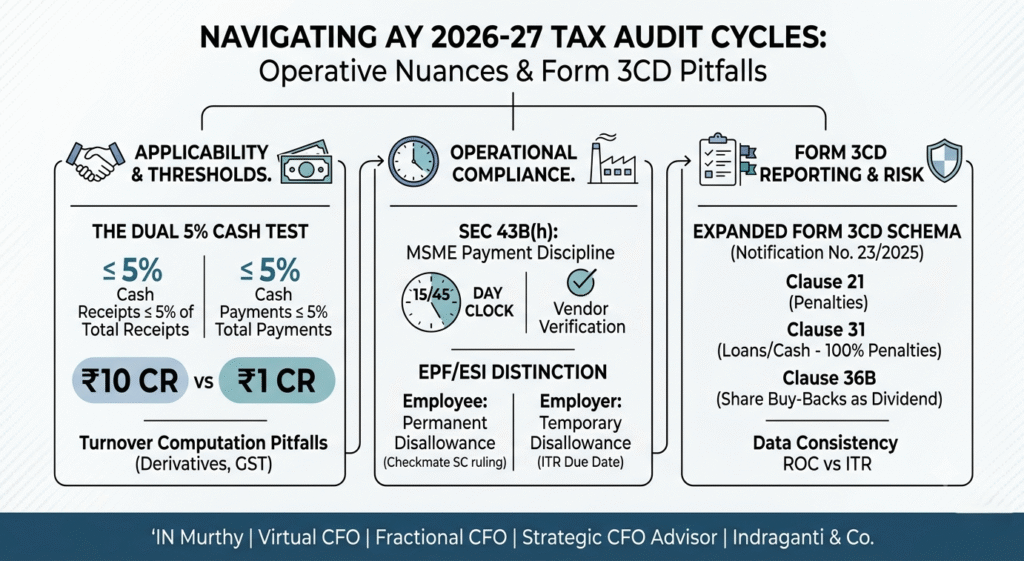
For finance leaders, CFOs, and business owners, the tax audit cycle for Financial Year 2025–26 (Assessment Year 2026–27) occupies a pivotal position. Not only is it the final audit cycle conducted under the Income-tax Act, 1961—ahead of the full rollout of the Income-tax Act, 2025—it is also the first full cycle governed by the extensive Form 3CD amendments introduced via the Income-tax (Eighth Amendment) Rules, 2025 (Notification No. 23/2025).
Beyond mere compliance, tax audit reporting directly impacts an enterprise’s working capital cycle, banking lines, and tax friction. Below is an analysis of the key statutory nuances, operational traps, and reporting requirements that decide applicability and tax reporting for AY 2026–27.
-
The 5% Cash Test in Section 44AB: Two Independent Ratios, Not One
Section 44AB(a) mandates a tax audit when total sales, turnover, or gross receipts exceed ₹1 crore. The threshold jumps to ₹10 crore provided the cash receipts and cash payments do not exceed 5% of their respective totals.
The three critical nuances often overlooked during mid-year planning:
- Dual Cumulative Test: The receipts and payments conditions are independent and cumulative. A business with zero cash sales that pays 6% of its operational expenses, logistics, or labor in cash fails the test and reverts to the lower ₹1 crore threshold.
- The Denominator Fallacy: Cash receipts are tested against total receipts (including equity injections, loan proceeds, asset sales, and GST refunds). Cash payments are tested against total payments (including loan repayments, capital expenditure, and taxes). Testing these cash fractions against turnover—a common shortcut—distorts the ratio and exposes the company to audit non-compliance.
- Non-Account Payee Instruments: Cheques or drafts that are not strictly “Account Payee” (such as bearer or self-drawn instruments) are legally deemed cash under the proviso to Section 44AB.
[ 1. DUAL 5% CASH TEST ]
Two Independent Ratios - Cash Receipts / Total Receipts ≤ 5%
- Cash Payments / Total Payments ≤ 5%
**Tested against Total Cash Flow, NOT Gross Turnover.
2. Turnover Computation: Derivatives, GST, and Asset DisposalsBecause the Income-tax Act does not explicitly define “turnover,” businesses must rely on the revised ICAI Guidance Note on Tax Audit under Section 44AB (Revised 2026):
- Derivatives & F&O: Under updated ICAI guidance, option premiums received on the sale of options are no longer added separately to absolute profit/loss figures. Using legacy tax audit utilities will artificially inflate turnover and pull non-applicable businesses into audit.
- GST Treatment: If using the exclusive accounting method (routing GST through a balance sheet liability account), GST is excluded from turnover. If using the inclusive method, GST forms part of gross turnover. Reclassifying accounting methods in Q4 simply to evade the audit threshold invites immediate scrutiny.
- Capital Disposals: Receipts from fixed asset liquidations, scrap investments, or capital adjustments must be excluded from turnover calculations.
-
Section 44AB(e) and the 5-Year Lockout Trap
Under Section 44AD(4), if an eligible business opts out of the presumptive taxation scheme in any given year, it is barred from re-entering Section 44AD for the next five consecutive assessment years.
Under Section 44AB(e), if the business’s total income exceeds the basic exemption limit during any of these lockout years, a mandatory tax audit applies regardless of turnover. A small enterprise with ₹35 lakh in turnover that opts out of presumptive tax during a single loss-making year triggers a 5-year mandatory audit obligation.
-
Section 43B(h) & Clause 22: MSME Payment Discipline and Disallowance
Section 43B(h) enforces payment discipline toward Micro and Small Enterprises (MSEs) registered under the MSMED Act, 2006.
SECTION 43B(h) DEDUCTION TIMELINE
- [ Written Agreement Exists ] –> Must Pay Within Agreed Period (Max 45 Days)
- [ No Written Agreement ] –> Must Pay Within 15 Days
Strategic Nuances for Clause 22 Reporting
- Clock Runs From Delivery, Not Invoice Date: The 15-day or 45-day timer starts on the date of actual delivery/acceptance of goods or services (or deemed acceptance), not the invoice billing date.
- Trader Exclusion: Wholesale and retail traders registered under Udyam are excluded from the payment terms of Section 15 of the MSMED Act for Section 43B(h) purposes (applicable primarily to manufacturers and service providers).
- Cross-Registry Verification: Disallowances reported in Clause 22 of Form 3CD must match the vendor master Udyam classifications and align with the biannual MSME Form I filed with the Registrar of Companies (ROC).
- Employee EPF/ESI (Clause 20b) vs. Employer EPF/ESI (Clause 26)
Following the Supreme Court ruling in Checkmate Services Pvt. Ltd., the distinction between employee and employer contributions is strictly enforced:
Contribution Type Governing Section Statutory Deadline Consequence of Late Payment Form 3CD Disclosure Employee Contribution Sec 36(1)(va) r.w.s. 2(24)(x) Due date under the respective Provident Fund / ESI Act Permanent Disallowance. Cannot be claimed even if paid before Tax Return filing. Clause 20(b) (Reported month-by-month) Employer Contribution Sec 43B(b) Due date for filing Income Tax Return u/s 139(1) Temporary Disallowance. Allowed in the year of payment. Clause 26 Note: Delays reported under Clause 20(b) trigger automated tax demand adjustments under Section 143(1)(a).
- Key Form 3CD Amendments (Notification No. 23/2025)
The updated Form 3CD schema expands disclosure requirements across several key clauses:
- Clause 21 (Penalties & Settlement Fees): Mandates explicit reporting of expenses incurred to settle proceedings for law contraventions (corresponding to Explanation 3 to Section 37(1)).
- Clause 31 (Loans, Deposits & Cash Receipts): Structured around mandatory reporting codes for Sections 269SS, 269T, and 269ST transactions. Non-compliance carries equal 100% penalties under Sections 271D, 271E, and 271DA.
- Clause 36B (Share Buy-Backs): Aligned with the tax regime where buy-back proceeds are taxed entirely as dividend income under Section 2(22)(f). Form 3CD requires reporting both the gross dividend receipt and the cost of acquisition (claimable as a capital loss).
Executive Summary Checkup for Finance Leaders
To ensure operational readiness before audit sign-off:
- Working Capital Audit: Have you audited outstanding MSME payables as of March 31 against actual delivery dates and Udyam classifications?
- Dual-Ratio Verification: Are cash receipts and payments verified against total cash flow (including capital/debt receipts) rather than gross turnover?
- Payroll Reconciliation: Are monthly EPF/ESI employee deductions matched against actual deposit dates to prevent permanent tax disallowances?
- Data Consistency: Does Form 3CD Clause 22 match your ROC MSME Form I, and do Clause 20(b) entries reconcile with Form 26AS/AIS records?
Are you still treating the Annual Income-Tax exercise as a Compliance arrangement or a tool for Cash & Business Management?
Let’s connect and talk.
.