The numbers raise a red flag. Everyone sees it. But nobody panics.
It starts with a simple “Let’s see how next month goes.” Then next month comes. Next quarter comes. And the problem persists.
The drift into serious trouble rarely happens in one big moment. It happens through small, unchallenged decisions:
- A 30-day payment extension here.
- A “just this once” margin exception there.
- Retaining a loss-making product for “volume.”
This is where true finance leadership is critical. It’s not about another report; it’s about being another pair of eyes on the decisions.
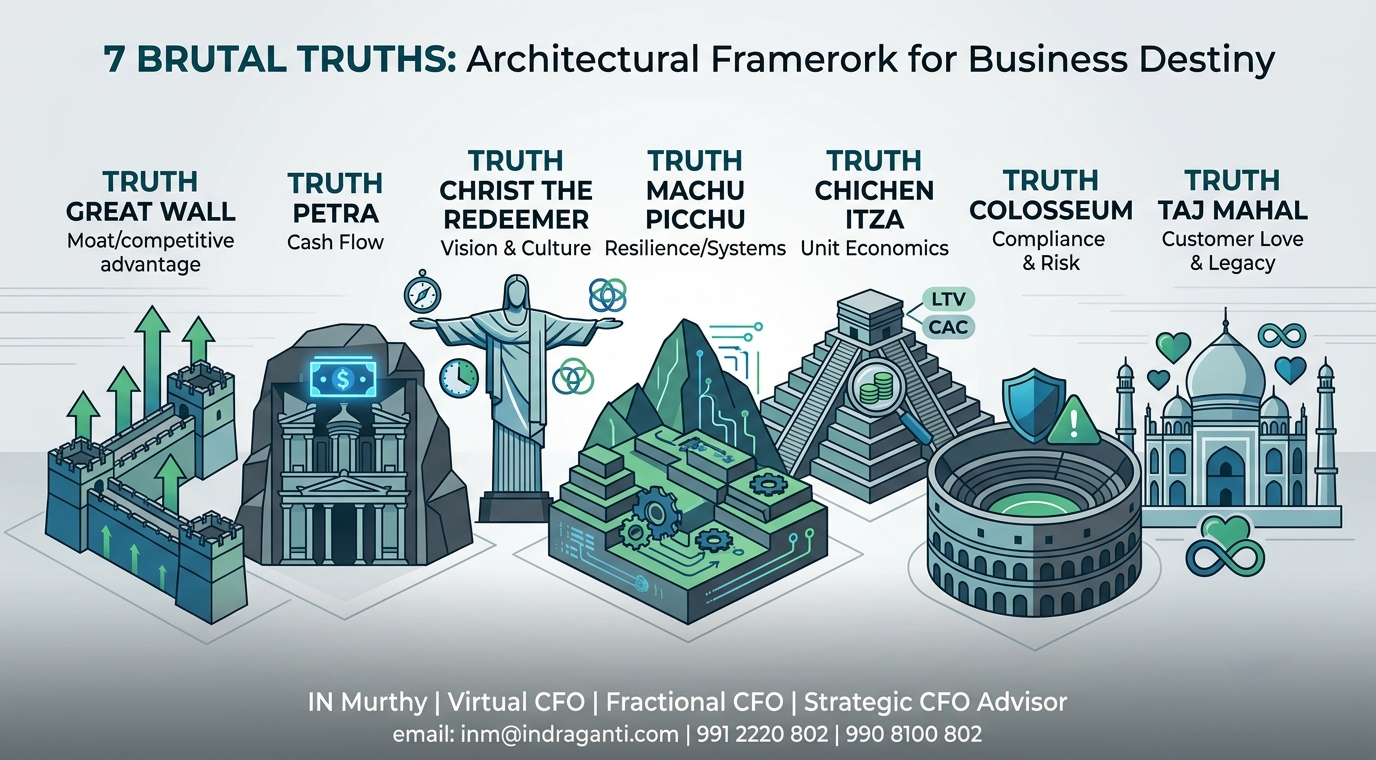
Inspired by the concept of the 7 Wonders of World, Here are, 7 Brutal Truths that every business must address to master its destiny.
Analyze your business by asking these 7 Questions for each truth:
-
THE GREAT WALL: Master Your Moat
Truth: Profit is vanity, Moat is sanity. A moat is your sustainable competitive advantage.
- WHAT is our moat? (Brand, IP, high switching costs, unique supply chain).
- WHY must we protect it? To prevent commoditization and ensure long-term value.
- WHERE are the biggest threats coming from? Identify current competitors and potential disruptors.
- WHEN should we double down on it? Constantly. A moat must be actively widened.
- WHOM does it protect us from? Specific market forces and competitors.
- HOW do we measure its strength? Customer retention, pricing power, R&D/revenue ratio.
-
PETRA: Cash Flow is King
Truth: You don’t die from lack of profit; you die from lack of cash. Profit is an opinion; cash is a fact.
- WHAT is our runway? The exact number of months we can survive with current burn and no revenue.
- WHY do profitable businesses run out of money? Slow accounts receivable, over-investing in inventory, or high customer acquisition costs (CAC) paid upfront.
- WHERE is our cash trapped? Analyze the working capital cycle (receivables, inventory, payables).
- WHEN will our bank balance hit zero? Project precise, realistic cash flow timelines.
- WHOM must we collect from faster? Segment customers by payment reliability and tighten terms.
- HOW do we improve liquidity today? Shorten billing cycles, negotiate better supplier terms, optimize inventory.
-
CHRIST THE REDEEMER: Align Your Vision & Culture
Truth: Numbers keep score, culture wins the game. A powerful vision and culture align every decision.
- WHAT is our ultimate vision? Beyond revenue—what change do we want to create?
- WHY does it matter to our team? Purpose drives motivation far more effectively than money alone.
- WHERE do we communicate this vision? In hiring, daily stand-ups, and strategic reviews.
- WHEN must we prioritize culture? In every difficult conversation and major hiring decision.
- WHOM must embody this culture? The founders, leadership, and every single employee.
- HOW do we measure cultural health? Employee net promoter score (eNPS), turnover rates, behavioral consistency.
-
MACHU PICCHU: Build for Resilience
Truth: Growth without systems is chaos. Build the foundations before scaling.
- WHAT core systems will break at 2x growth? Financial systems, supply chain, customer support.
- WHY do internal systems lag behind growth? Because success often masks operational weaknesses.
- WHERE are our data silos? Systems that do not communicate create decision-making dead zones.
- WHEN must we pause growth to build infrastructure? Before scaling the organization.
- WHOM needs better processes? Every department must map out its core workflows.
- HOW do we build “reusable” systems? Standardize procedures and automate workflows before they become bottlenecks.
-
CHICHEN ITZA: Unpack Unit Economics
Truth: If you don’t know your unit economics, you are gambling.
- WHAT is the contribution margin of our best product? Revenue minus variable costs.
- WHY does it matter? To understand if we are scaling profit or scaling losses.
- WHERE is our CAC (Customer Acquisition Cost) too high? Analyze specific marketing channels.
- WHEN should we raise prices? When the LTV (Lifetime Value) to CAC ratio is too low, or demand consistently outstrips supply.
- WHOM is our most profitable customer? (Segment by profitability, not just revenue).
- HOW do we calculate LTV correctly? Based on real retention data and contribution margin, not revenue.
-
COLOSSEUM: Master Compliance & Risk
Truth: Risk and Compliance are not back-office; they are survival.
- WHAT are our top 3 existential risks? Competitive, legal/regulatory, or dependency on a single supplier/client.
- WHY are we avoiding uncomfortable risk discussions? (This is often the core of the “drift.”)
- WHERE are the hidden operational risks? In single points of failure, unpatched systems, or key-man dependencies.
- WHEN must risk assessment occur? Quarterly reviews, and before every new initiative.
- WHOM is accountable for risk mitigation? Specific leadership roles must have clear risk-management KPIs.
- HOW do we turn risk into a competitive advantage? Robust systems (e.g., in supply chain or data security) become product differentiators.
-
TAJ MAHAL: Invest in Customer Love & Legacy
Truth: Retention is the only moat that compounds.
- WHAT is our customer retention rate? The true percentage of customers we keep year-over-year.
- WHY is new customer acquisition often a trap? High CAC makes it much harder to generate long-term value.
- WHERE are customers churning? Map the customer journey to find the friction points.
- WHEN do we over-invest in existing relationships? Always. Churn must be battled at every touchpoint.
- WHOM are our “Promoters”? The advocates who amplify our brand organically.
- HOW do we build a lasting legacy? By focusing on customer-centricity as a core operating principle, not just a marketing slogan.
Good finance doesn’t wait for the numbers to become alarming. It notices the drift. It challenges the story. It challenges the strategy.
Which of these 7 Brutal Truths is your business avoiding discussing?
IN Murthy
| Virtual CFO | Fractional CFO | Strategic CFO Advisor |